Recipes, crafts and so much more!
Lughnasadh literally translates as “loaf mass” — the first-harvest festival, traditionally marked by baking bread from the season’s first grain. So this week, instead of something sweet, we’re doing something a bit more elemental: a simple, generously-seeded loaf that fills the kitchen with that unbeatable fresh-bread smell.
This isn’t a fussy sourdough situation — it’s a straightforward yeasted loaf, mostly hands-off, that rewards patience more than skill.
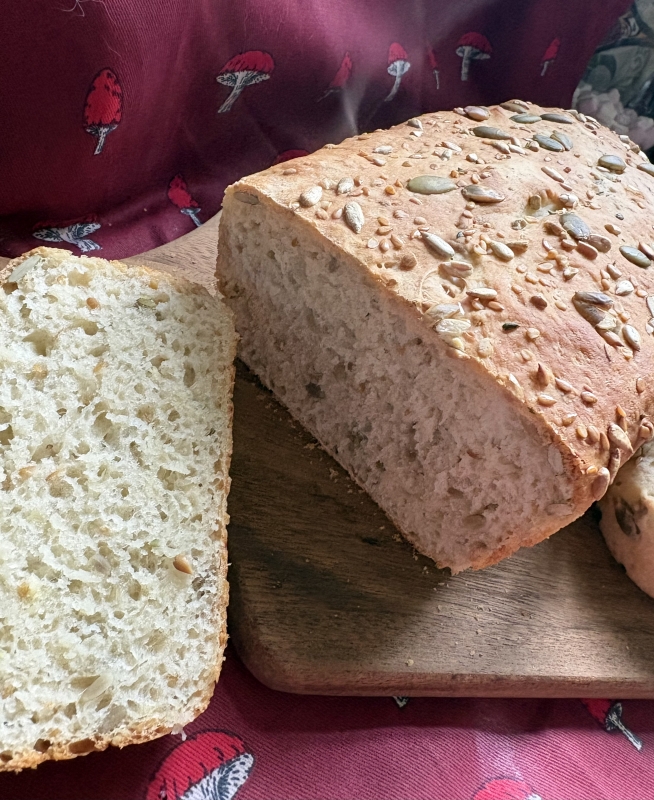
There’s something quietly satisfying about a loaf of bread you made yourself — it feels like exactly the kind of first-harvest gesture this sabbat is built around, even if your “harvest” this year was really just a trip to the shop for flour. The seeds worked through the dough and scattered over the crust give it a proper rustic, “this took effort” look, for very little actual effort.
Ingredients
1. Mix dry ingredients: In a large bowl, mix 500 grams strong white bread flour, plus extra for dusting, 100 grams mixed seeds (sunflower, pumpkin, linseed), plus extra for topping, and 10 grams salt together.
2. Prepare the yeast liquid: In a jug, stir 1 tablespoons honey and 7 grams fast-action dried yeast into 350 milliliters warm water until dissolved.
3. Combine into a shaggy dough: Pour the liquid into the dry ingredients and mix with a spoon or your hands until you have a rough, shaggy dough. It will look messy — that’s fine.
4. Rest: Cover the bowl and leave the dough to rest.
5. Fold the dough: With wet hands, fold the dough over on itself a few times in the bowl (no need to turn it out). Cover again.
6. Bulk rise: Leave somewhere warm to rise until roughly doubled in size.
7. Shape the loaf: Tip the dough onto a lightly floured surface and shape gently into a round. Place on a lined baking tray, scatter extra 100 grams mixed seeds (sunflower, pumpkin, linseed), plus extra for topping over the top, and press in lightly.
8. Second rise: Cover loosely and leave to rise again while the oven heats to 220°C fan (240°C/475°F conventional).
9. Bake: Score the top with a sharp knife and bake until deep golden and the base sounds hollow when tapped.
10. Cool: Cool on a wire rack for at least 20 minutes before slicing — it’ll still be cooking a little inside as it cools.
Bread has long carried harvest symbolism — literally the transformation of grain into nourishment, which is about as tidy a metaphor for gratitude as you’ll find. If you want to bring a small ritual into it: set an intention while kneading, or break the first piece and set it aside as an offering of thanks before you eat.
Full Lughnasadh ritual notes over on @spellandhearth this week.
